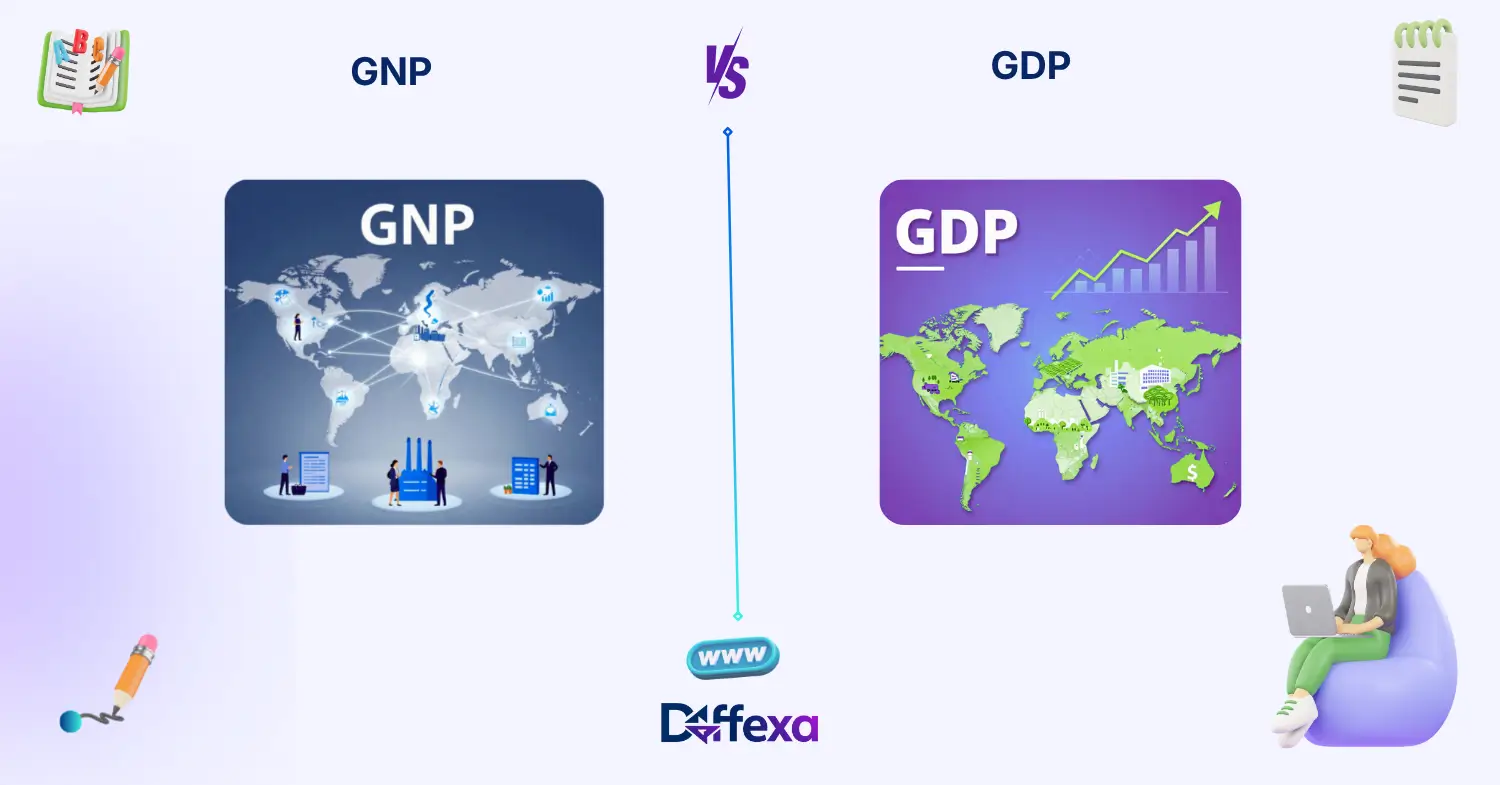
Difference between gnp and gdp becomes important when students start learning economics and hear experts talking about a country’s economic growth on the news. You might hear that a country’s GDP increased or its GNP declined, but the meaning often feels confusing.
In simple terms, GDP and GNP are both measures of a country’s economic performance. However, they focus on different aspects of income and production. Understanding the difference between gnp and gdp helps learners clearly see how national economies are measured and compared globally.
Many people use these terms interchangeably, but they are not the same. The difference between gnp and gdp mainly depends on where income is produced and who earns it. GDP focuses on production inside a country, while GNP focuses on income earned by citizens.
This beginner-friendly guide explains the difference between gnp and gdp in a simple and clear way so learners can understand global economics with confidence. Let’s start with the key difference between the two.
Key Difference Between the Two 📊
The main difference between GNP and GDP is based on location of production and ownership of income.
GDP (Gross Domestic Product) measures the total value of goods and services produced within a country’s borders.
GNP (Gross National Product) measures the total value of goods and services produced by a country’s citizens, whether inside or outside the country.
Simple explanation:
- GDP = Production inside the country 🏭
- GNP = Income of citizens worldwide 🌎
GDP focuses on location, while GNP focuses on ownership of income.
Why Is Their Difference Necessary to Know 📈
Understanding the difference between GNP and GDP is important for students because it builds a strong foundation in economics. It helps learners understand how countries measure growth and development in global markets.
Economists and policymakers rely on these measures to make financial and economic decisions. GDP shows domestic economic activity, while GNP reflects national income and international earnings.
Society benefits from this knowledge because it helps people understand economic reports, government policies, and global economic comparisons. This awareness improves financial literacy and global understanding.
Now, let’s learn how to pronounce these terms correctly.
Pronunciation 🔊
GNP
US: /ˌdʒiː en ˈpiː/
UK: /ˌdʒiː en ˈpiː/
GDP
US: /ˌdʒiː diː ˈpiː/
UK: /ˌdʒiː diː ˈpiː/
These abbreviations are commonly used in economic discussions and global reports. Correct pronunciation helps learners speak confidently in academic and professional settings.
Now, let’s explore their core definitions.
Core Definitions 📚
GNP (Gross National Product)
GNP measures the total value of goods and services produced by a country’s citizens, including income earned abroad. It focuses on national ownership of economic activity.
The tone is analytical and economic because it reflects national income.
Example:
A company owned by citizens earns money abroad, and that income is included in GNP.
GDP (Gross Domestic Product)
GDP measures the total value of goods and services produced within a country’s borders. It focuses on domestic production regardless of ownership.
The tone is also analytical and economic.
Example:
A foreign company operating inside a country contributes to GDP.
10 Clear Differences Between GNP and GDP 📊
1. Focus of Measurement
GNP focuses on citizens’ income worldwide.
GDP focuses on domestic production.
Example for GNP:
Income earned abroad is counted.
Example for GDP:
Production inside country is counted.
2. Location vs Ownership
GNP measures ownership of production.
GDP measures location of production.
Example for GNP:
Citizen-owned company abroad adds to GNP.
Example for GDP:
Foreign factory inside country adds to GDP.
3. Global vs Domestic Scope
GNP reflects global earnings.
GDP reflects domestic activity.
Example for GNP:
Overseas income included.
Example for GDP:
Local production included.
4. Economic Perspective
GNP shows national economic strength.
GDP shows internal economic growth.
Example for GNP:
National wealth measured.
Example for GDP:
Domestic growth measured.
5. Foreign Investment Impact
GNP excludes foreign company income inside country.
GDP includes foreign company income.
Example for GNP:
Foreign company profits excluded.
Example for GDP:
Foreign factory profits included.
6. Income Flow Consideration
GNP includes net income from abroad.
GDP does not include it.
Example for GNP:
Workers abroad income added.
Example for GDP:
Only domestic income counted.
7. Economic Analysis Use
GNP helps analyze national income.
GDP helps analyze production.
Example for GNP:
Used in national wealth studies.
Example for GDP:
Used in growth analysis.
8. International Comparison
GNP compares national earnings.
GDP compares domestic economies.
Example for GNP:
Country earnings worldwide.
Example for GDP:
Country production inside borders.
9. Government Policy Use
GNP supports international economic policy.
GDP supports domestic policy.
Example for GNP:
Foreign investment analysis.
Example for GDP:
Local development planning.
10. Economic Indicator Role
GNP measures national income strength.
GDP measures economic activity.
Example for GNP:
Shows citizen earnings.
Example for GDP:
Shows production level.
Why Knowing the Difference Matters 🎯
Students must understand the difference between GNP and GDP to build strong economic knowledge. It helps them understand global trade, national income, and economic growth clearly.
Professionals such as economists and policymakers need this knowledge to analyze global markets and economic performance. Accurate understanding helps in making better financial and economic decisions.
Society benefits because people understand economic reports and global financial trends more easily. This improves awareness of national and global economic conditions.
Real‑world consequences of confusion
Confusing GNP and GDP can lead to incorrect economic analysis and misunderstanding of national growth. It may result in wrong policy decisions or misleading economic comparisons.
Why People Get Confused 🧠
Similar Abbreviations
GNP and GDP look almost the same, which creates confusion.
Semantic Overlap
Both measure economic growth and national performance.
Context-Based Usage
Economists often use them together in reports.
Informal Speech Influence
Media sometimes uses GDP more frequently, making GNP less familiar.
Connotation & Emotional Tone 🎭
Connotation (bold) = the emotional meaning associated with a word.
GNP
Positive:
Represents national income strength.
Example:
GNP shows global earnings power.
Negative:
Can overlook domestic inequality.
Example:
High GNP may hide local problems.
Neutral:
Used in economic reports.
Example:
GNP measures national income.
GDP
Positive:
Represents economic growth.
Example:
GDP growth shows development.
Negative:
Does not reflect income distribution.
Example:
GDP may ignore poverty.
Neutral:
Used in global economic analysis.
Example:
GDP measures production.
Usage in Metaphors, Similes & Idioms 🗣
Economists often use simple metaphors.
GDP is like counting all goods produced inside a house, while GNP is like counting the income earned by family members everywhere.
GDP measures the home economy, while GNP measures the family income worldwide.
These metaphors help beginners understand easily.
Comparison Table 📊
| Feature | GNP | GDP |
|---|---|---|
| Meaning | National income worldwide | Domestic production |
| Tone | Analytical | Analytical |
| Usage | Global income analysis | Domestic economic analysis |
| Context | International economics | National economics |
| Formality | Formal economic term | Formal economic term |
Which Is Better in What Situation ⚖️
When to Use GNP
Use GNP when discussing national income and global economic participation. It helps analyze how much citizens earn worldwide and reflects international economic strength.
When to Use GDP
Use GDP when discussing domestic production and economic growth within a country. It helps measure economic activity and development.
Situational Clarity
Use GNP for global income analysis and GDP for domestic production analysis.
Contextual Correctness
Choosing the correct term ensures accurate economic understanding and communication.
Literary or Cultural References 📖
Book
Economics (Academic, Paul Samuelson, 1948)
Explains GDP and national income concepts in simple economic theory.
Movie
Inside Job (USA, 2010)
Discusses global economic systems and financial indicators.
FAQs ❓
1. What is the main difference between GNP and GDP?
The main difference is that GDP measures production within a country, while GNP measures income earned by citizens worldwide. GDP focuses on location, and GNP focuses on ownership. Both are important economic indicators. Economists use them to understand national performance.
2. Why is GDP more commonly used than GNP?
GDP is easier to measure because it focuses on domestic production. Governments and international organizations use GDP to track economic growth. It provides a clear picture of economic activity within a country. That is why it is widely used in global reports.
3. Does GNP include foreign income?
Yes, GNP includes income earned by citizens and companies abroad. It measures national income regardless of location. This makes it useful for global economic analysis. It reflects international earnings.
4. Can a country have high GDP but low GNP?
Yes, this can happen when foreign companies operate inside the country. GDP increases due to domestic production, but GNP remains lower because income goes to foreign owners. This shows the difference between domestic production and national income.
5. Which is better for measuring economic growth?
GDP is better for measuring domestic economic growth, while GNP is better for measuring national income. Both provide useful insights. Economists use them together for a complete picture. Each serves a different purpose.
Conclusion 🏁
The difference between GNP and GDP mainly lies in how economic activity is measured. GDP focuses on production within a country’s borders, while GNP focuses on income earned by a country’s citizens worldwide. This distinction helps economists understand both domestic growth and global economic participation.
Understanding this difference improves economic literacy and helps students, professionals, and policymakers analyze financial data more accurately. It also helps society better understand government reports and global economic trends.
By learning the difference between GNP and GDP, readers gain a clearer view of how economies function in a connected world. Keep exploring economic concepts step by step, and you will build strong knowledge of global finance and development 🌍📊

Michael Turner is a business and technology analyst with over 8 years of experience in digital content and market research. He specializes in business, finance, and technology comparisons, helping readers understand key differences between concepts, tools, and systems. At Diffexa, Michael focuses on delivering clear, structured, and research-based comparison articles.
Expertise:
- Business & Finance
- Technology
- Market Research
- Digital Systems